Environmental Education for a Better Earth Canada

Have a sustainability initiative in
mind? Let’s collaborate.
Contact Us
- +1 343 597 4664
- info@eefabecanada.org
- Toronto, Ontario
Subscribe
Follow Us
Planting More Than Trees: How a Young Canadian Woman Is Redefining Environmental Leadership

In a world often overwhelmed by climate anxiety, despair, and inaction, stories of quiet determination matter more than ever. They remind us that real change does not always begin in conference rooms or board offices, but sometimes with a shovel, a seedling, and an unshakable belief that individual action matters.
Meet Stella Cimicata, a 23‑year‑old Canadian environmentalist, tree planter, and recent graduate of Dalhousie University whose journey from a reluctant hiker to a nationally experienced reforestation worker is inspiring thousands of young people across Canada and beyond. Over the past four summers, Stella has planted more than 400,000 trees across British Columbia, contributing directly to forest recovery following logging operations and devastating wildfires.
But her story is not just about numbers. It’s about resilience, consistency, and purpose—and why young people hold more power in shaping the planet’s future than they may realize.
From City Kid to Forest Steward
Stella grew up in the suburbs of Toronto, in what she describes as a “very city family.” While her family often went hiking along the Bruce Trail and in conservation areas, she admits that as a child, she hated it. Nature was not yet her passion. That transformation came later, slowly, and authentically.
A turning point arrived in her early teens through summer camps, outdoor education, and multi‑day canoe trips in Ontario’s backcountry. What began as reluctant exposure evolved into deep appreciation and, eventually, commitment. By her late teens, the outdoors had become central to her identity.
That passion carried into her academic path. Stella earned a Bachelor’s degree in Environmental Science and Geography from Dalhousie University in Nova Scotia, a program that deeply integrates environmental theory with real‑world application. While at Dalhousie, she served as a trip leader with the Dalhousie Outdoors Society, mentoring peers and encouraging students to build meaningful connections with nature.
Her academic success was not separate from her environmental work; it was strengthened by it.
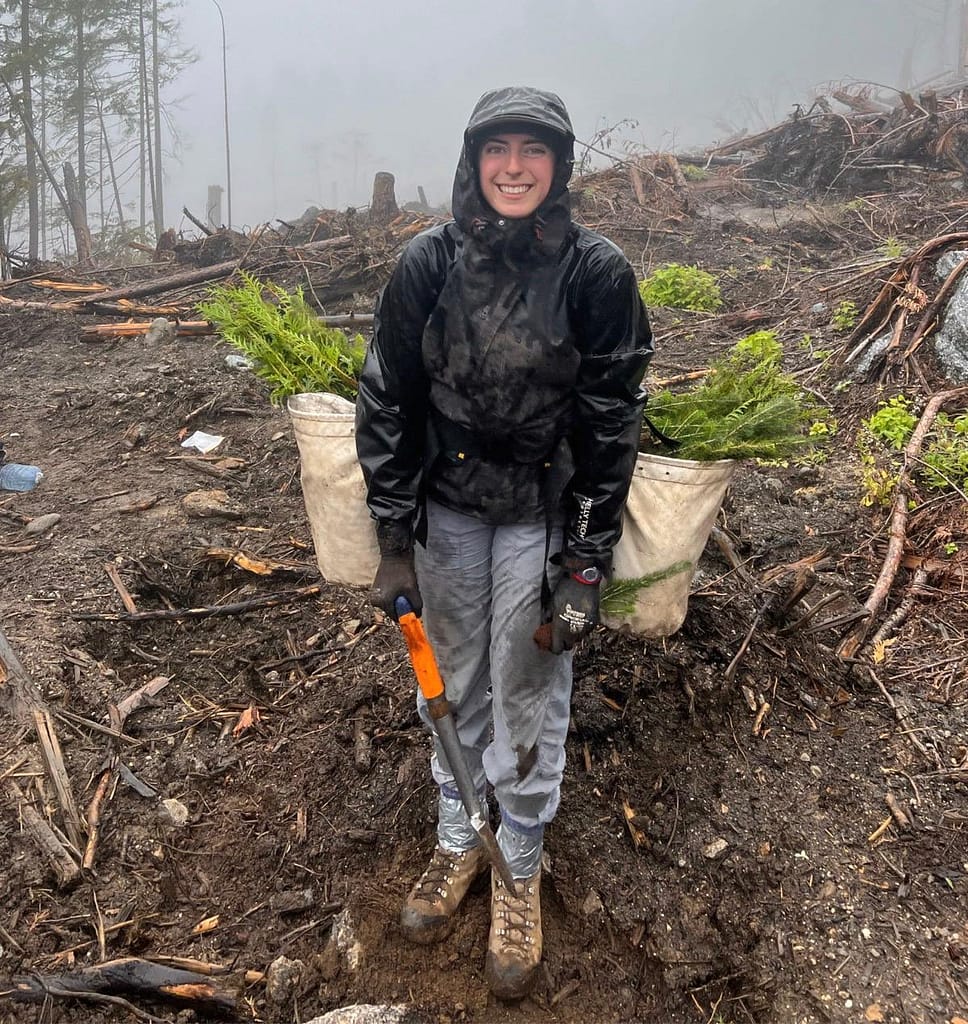
Discovering Tree Planting: Choosing the Hard Path
At 19 years old, following her first year of university, Stella made a bold decision. After working as a summer camp counsellor, loving the labour but not the low pay, she discovered professional tree planting through a news article her mother shared.
That single article changed the course of her life.
Tree planting promised long days, intense physical labor, mental endurance, and life in remote forests. It also promised purpose. Stella applied immediately, despite never having heard of the profession before.
Her first day shocked her.
Tree planters carry up to 50 pounds of equipment, bend thousands of times per day, work through rain, snow, heat waves, and insect swarms, and often plant alone for 8 to 10 hours in remote terrain. Yet, instead of discouraging her, the hardship became her motivation.
“If I can push through this,” Stella reflected, “I know I can push through anything.”
Also read: Environmental Education & Climate Action in 2026 | EEFABE Canada New Year Message
Four Summers, Four Hundred Thousand Trees
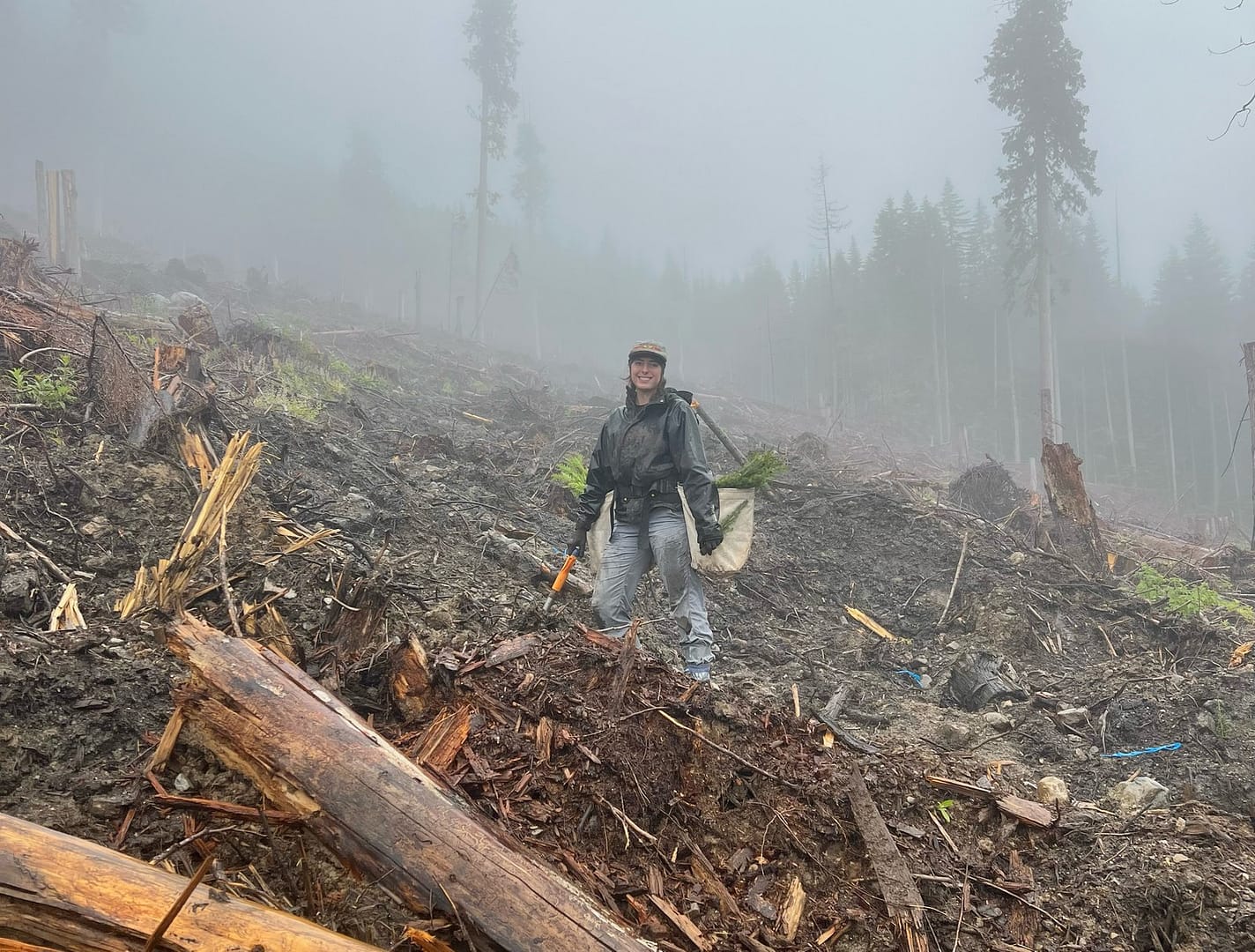
Over four planting seasons, totalling approximately 11 months of active planting, Stella averaged nearly 100,000 trees per summer. She worked across northern and southern British Columbia, often in post‑wildfire zones and clear‑cut lands mandated for reforestation under Canadian forestry laws.
Despite working in crews of 6–18 planters, most of her day was spent alone in the forest, sometimes in bear territory, with only her training, discipline, and commitment driving her forward.
This level of output requires more than physical strength. It demands mental resilience, self‑discipline, and unwavering consistency, qualities Stella embodies.
A Woman Thriving in a Demanding Industry
Tree planting is one of the few outdoor industries where women and men participate in nearly equal numbers. Stella describes it as an empowering, merit‑based environment where success is defined not by size or gender, but by mental strength.
She challenges stereotypes directly.
“Some of the strongest planters I know,” she says, “are smaller women who are incredibly tough mentally.”
Her success sends a powerful message to young women worldwide: there is space for you in environmental leadership, even in physically demanding fields.
Bridging Education and Climate Action
What sets Stella apart is her ability to connect theory with practice.
While studying forestry, climate systems, and environmental policy at university, she was simultaneously witnessing reforestation on the ground. This dual perspective allowed her to engage critically with debates about logging, climate action, and sustainable land management, not from ideology alone, but from lived experience.
She openly acknowledges the complexity of reforestation, recognizing both its role in carbon sequestration and its connection to logging economies, while maintaining a strong ethical stance: doing the work responsibly matters.
Why Young People Matter More Than Ever
Stella believes the greatest strength of young people today lies in energy, physical, mental, and emotional.
In her words, young people must resist the narrative that “nothing we do matters” in the face of climate change. Individual action, she insists, creates collective momentum.
Her own lifestyle reinforces this belief. A committed vegan for nearly five years, she sees daily choices, meals, transportation, and community engagement as deeply political and environmental acts.
“You don’t need a big organization or money to make an impact,” she says. “You just need to start.”
Advice to Young Environmental Leaders
To young people who want to take action but feel overwhelmed, Stella offers simple, grounded advice:
- Start small, especially with daily habits
- Spend time outdoors—connection inspires protection
- Don’t wait for perfection—action matters more
- Be consistent, even when progress feels slow
- Lean into struggle, because growth lives there
Her philosophy is refreshingly honest: environmental leadership is not glamorous every day, but it is meaningful.
A Vision Rooted in Hope
Looking ahead, Stella envisions a future where Canada continues to balance economic needs with environmental protection, preserving forests, water systems, and biodiversity for future generations. She hopes to expand her impact beyond trees planting into broader forestry, resilience planning, and urban greening initiatives.
Though she may step away from full‑time planting, she is clear about one thing:
“I’ll never stop planting trees.”
Whether through policy, science, education, or hands‑on restoration, her life’s work will remain rooted in forests.
A Legacy Written in Trees
When asked how she wants to be remembered, Stella offers a powerful response:
“Less about people remembering me and more about forests being healthy again.”
One day, travelers may pass thriving forests in British Columbia without knowing her name. But the trees will know. The water will know. And the future will be better because a young woman decided to act.
Final Message to Young People Worldwide
“Every action has an impact—positive or negative,” Stella says. “So you might as well make it positive.”
In a time when the planet needs courage more than comfort, her story is a reminder: you don’t have to wait to be powerful. You already are.
Want to support our work? Donate and help lead the change for a better Earth

Ulrich Stephane Tamo
Hi, my name is Ulrich Stephane Tamo. I am an environmental activist and ocean lover. I love to travel and write blogs.
One thought on “Planting More Than Trees: How a Young Canadian Woman Is Redefining Environmental Leadership”