
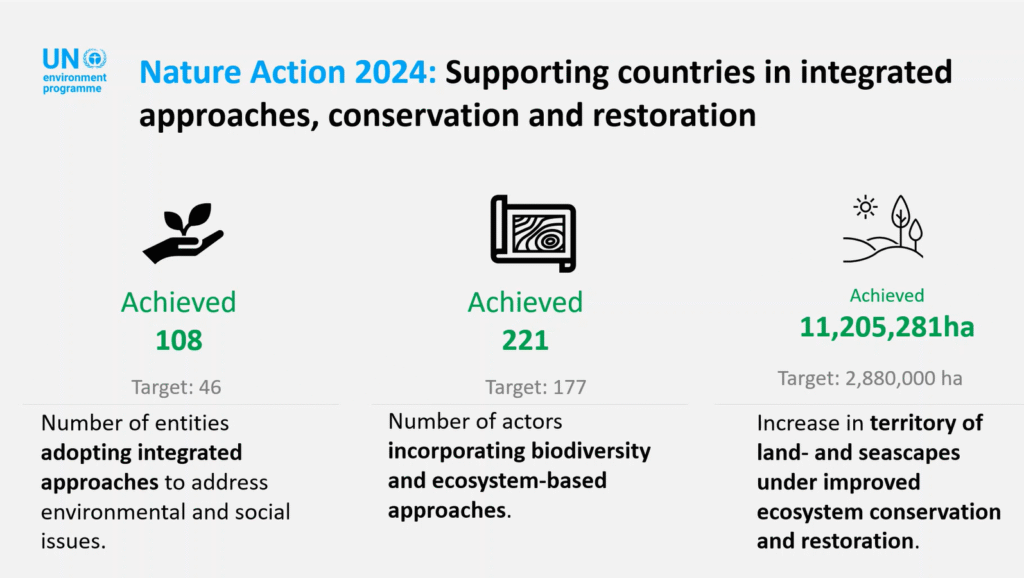
At the Nairobi subcommittee meeting, one statistic captured my attention more than any other: UNEP’s Nature Action portfolio did not just meet expectations in 2024. It shattered them.
Targets were ambitious: 46 entities adopting integrated approaches to address environmental and social issues, 177 actors incorporating biodiversity and ecosystem-based solutions, and 2.88 million hectares of land and seascapes under improved ecosystem conservation and restoration. The results? 108 entities, 221 actors, and a staggering 11.2 million hectares conserved or restored.
This is not incremental progress; it is transformational. As we heard delegates emphasize, such scale demonstrates that nature-based solutions are gaining traction as mainstream development strategies, not peripheral projects.
The breadth of adoption suggests a shift in mindset. Governments, businesses, and civil society organizations are increasingly recognizing that healthy ecosystems are not obstacles to development but enablers of resilience and prosperity. From mangrove restoration in coastal zones to reforestation projects in Africa’s drylands, the restoration agenda is becoming visible at national and regional scales.
Also read: Climate Action at a Crossroads AS Transparency and Finance Take Center Stage
But there’s another layer. Sitting in Nairobi, I cannot ignore how this “success story” must be interrogated. Are these hectares under restoration translating into real benefits for communities on the ground? Conservation without equity risks reproducing exclusion, particularly for Indigenous peoples and local communities whose stewardship has long safeguarded biodiversity.
The discussion in the meeting room pointed to this duality: success on paper must align with justice in practice. We must ask whether restored landscapes are inclusive, community-led, and climate-resilient, not merely counted in hectares.
At Environmental Education for a Better Earth Canada, nature-based solutions are at the heart of our climate resilience strategy. As highlighted during the Nairobi subcommittee meeting, the scale of global restoration efforts is unprecedented, but we believe the true measure of success lies in how these efforts uplift communities.
Our organization actively engages in reforestation, agroecology, and biodiversity education programs that center local knowledge and community leadership, particularly among African diaspora youth and Indigenous partners. We view healthy ecosystems not just as carbon sinks, but as foundations for economic empowerment, food security, and cultural preservation. Looking ahead, EEFABE Canada is committed to deepening our impact by scaling inclusive restoration initiatives and advocating for equitable climate finance that reaches grassroots custodians of biodiversity. Because for us, nature action is not just about hectares. It’s about healing landscapes and lives together.
The 2024 results leave me both inspired and cautious. Inspired by the magnitude of progress, cautious because the next frontier is not expansion, but deepening, ensuring that nature action becomes people-centered action.
Reference: UNEP program performance report 2024


 Français du Canada
  English (Canada)