Éducation Environnementale pour Un Terre Meilleure (EEFABE) Canada

Vous avez une initiative en développement durable
en tête? Collaborons afin de créer ensemble un impact environnemental durable.
Contactez‑nous
- +1 343 597 4664
- info@eefabecanada.org
- Toronto, Ontario
Abonnez-vous
Suivez-nous

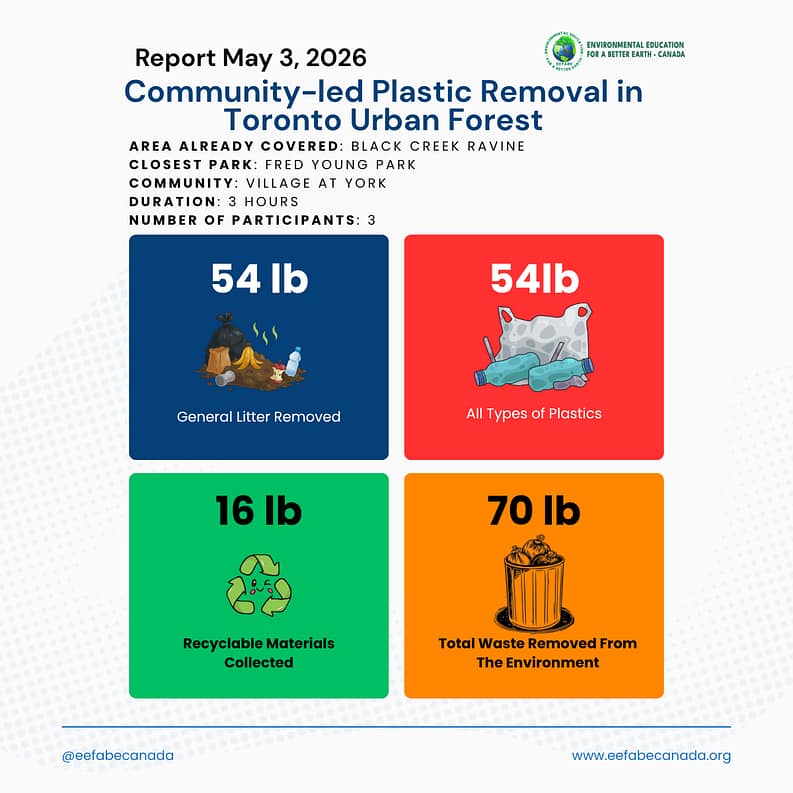
On Sunday, May 3rd, 2026, Environmental Education for a Better Earth Canada continued its on‑the‑ground environmental action by conducting a targeted plastic removal (litter) operation within the Black Creek Parkland Ravine and surrounding green spaces. The activity focused on the ravine corridor behind Fred Young Park, one of Toronto’s most ecologically sensitive urban forest systems.
This operation, which ran from 10:00 a.m. to 1:00 p.m., is part of Environmental Education for a Better Earth Canada’s long‑term commitment to protecting urban forests, watershed systems, and biodiversity through direct action, community engagement, and environmental stewardship.
Leadership and Community Engagement
The success of this plastic removal cleanup was led from the forefront by the Executive Director of Environmental Education for a Better Earth Canada, supported by two dedicated volunteers. Together, the team undertook the physically demanding and often overlooked work of removing plastic waste embedded deep within forested areas, beneath shrubs, tangled in grasses, and hidden along ravine slopes.
Unlike surface plastic removal cleanups, this operation prioritized abandoned and long‑standing plastic pollution, much of which had been decomposing slowly in the ecosystem for years. These plastics are rarely visible to casual visitors, yet they pose some of the most serious long‑term threats to forest health.
Why Black Creek Ravine Matters
The Black Creek Ravine is part of a larger watershed system that plays a vital role in:
- Stormwater regulation
- Soil stabilization
- Urban climate resilience
- Wildlife habitat and migration corridors
The ravine system supports birds, small mammals, pollinators, native plant species, and aquatic life downstream. As one of Toronto’s most sensitive ecological corridors, its protection is essential not only for biodiversity, but also for the well‑being of surrounding communities.
Importantly, this area is located within a Neighbourhood Improvement Area (NIA) as identified by the City of Toronto. Neighbourhood Improvement Areas often experience:
- Higher population density
- Increased development pressure
- Limited access to green infrastructure
- Greater exposure to environmental stressors
As population growth and urban development continue, the volume of plastic entering these natural systems increases, whether through recreational use, illegal dumping, wind dispersal, or stormwater flow.
How Plastic Enters the Ravine Ecosystem
The plastics removed during this operation were introduced through multiple pathways:
- Discarded waste from park and trail users
- Litter blown into forested areas by wind
- Plastics transported by surface runoff during rainfall events
- Legacy waste abandoned for years and overgrown by vegetation
Once plastics enter forest ecosystems, they do not remain inactive. Over time, they fragment into smaller particles, block sunlight, alter soil composition, restrict plant growth, and introduce microplastics into soils and waterways.
This process accelerates ecosystem stress, compounding the impacts of climate change on urban forests that are already struggling with heat, drought, invasive species, and habitat fragmentation.

Environmental and Climate Implications
Plastic pollution magnifies climate impacts by:
- Preventing natural soil regeneration
- Interfering with plant root systems
- Contributing to urban heat stress
- Disrupting water infiltration and drainage
- Introducing toxins into food chains
Urban forests like Black Creek Ravine are critical climate buffers. When plastics accumulate unchecked, their ability to perform these functions is significantly reduced.
This aligns with findings from the City of Toronto’s Litter Audit, which consistently shows that plastic waste, especially single‑use plastics, dominates litter found in high‑use public spaces and natural areas across the city.
Global Context: The Intergovernmental Negotiating Committee (INC)
Environmental Education for a Better Earth Canada’s local action at Black Creek Ravine directly connects to global efforts under the United Nations Intergovernmental Negotiating Committee (INC) on Plastic Pollution, which is currently working toward a legally binding Global Plastics Treaty.
The treaty recognizes that:
- Plastic pollution is a lifecycle problem
- Plastic impacts ecosystems, climate, and human health
- Solutions must combine policy, innovation, and community action
Local plastic removal cleanups like this one demonstrate on‑the‑ground implementation of treaty principles, proving that global commitments require local leadership to succeed.
Results of the Plastic Removal Cleanup Operation
During the three‑hour operation, the team removed a total of:
70 pounds of waste
- 16 pounds were reusable or recyclable materials, sorted appropriately
- The remaining waste was safely bagged and disposed of following local guidelines
Waste items collected included:
- Plastic bottles and caps
- Plastic straws
- Single‑use snack wrappers
- Beauty and personal care containers
- Gas lighters
- Tennis balls
- Shoes and clothing
- Toys
- Aluminum cans
- Beer and wine bottles
- Mixed plastic fragments embedded in soil
Much of this waste had been abandoned for long periods, tightly woven into grasses and forest undergrowth, posing severe barriers to plant growth and natural regeneration.
Why Plastic Removal Matters
Removing plastic from forest ecosystems:
- Restores space for native plants to grow
- Protects habitats for wildlife
- Reduces microplastic contamination
- Improves watershed health
- Strengthens urban climate resilience
This work cannot be deferred. The longer plastics remain in forests and ravines, the more permanent their damage becomes.
A Collective Responsibility and a Call to Action
Protecting Toronto’s ravines and urban forests is a shared responsibility between communities, nonprofits, governments, and institutions.
Environmental Education for a Better Earth Canada invites:
- Volunteers
- Community members
- Corporate partners
- Funders and grantors
to join us in ongoing plastic removal cleanup operations, environmental education, and urban ecosystem protection.
👉 Volunteer sign‑up
👉 Partnership and funding inquiries are welcome info@eefabecanada.org
Together, we can remove what harms nature and restore what allows it to thrive.

Ulrich Stephane Tamo
Hi, my name is Ulrich Stephane Tamo. I am an environmental activist and ocean lover. I love to travel and write blogs.
One thought on “Community‑Led Plastic Removal in Black Creek Ravine: Protecting Urban Forests and Biodiversity in Toronto”